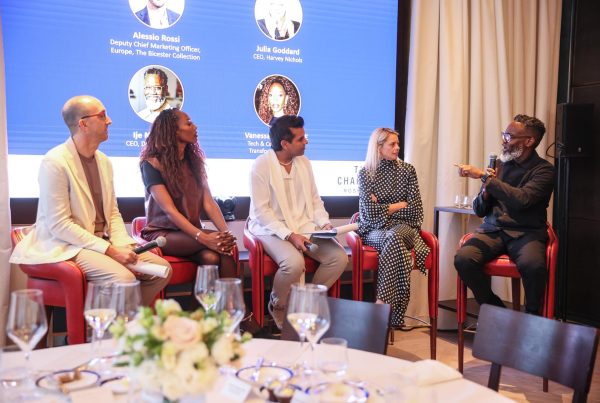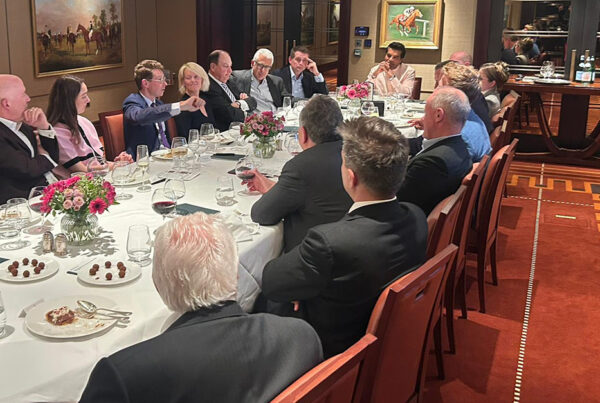


On Wednesday, 2 April, we held a Chief People Officer breakfast event in London with Audeliss and Eightfold AI. This event brought together leaders who offered a dynamic and insightful conversation around the evolving role of the CPO, the increasing influence of AI, data literacy in HR, and preparing workforces for a fast-changing landscape. Across all topics, there was a clear sense that the people function is entering a new chapter where agility, human-centered leadership, and tech fluency will define success.
We were joined by Monique Carter, People & Operations Director at Anglo American, Nicola Kowalckzuk, Chief People Officer at JD Sports, and Teresa Wykes, Senior Director, Talent-Centred Transformation at Eightfold, who shared their insights on what people leaders should be thinking about when shaping a function ready for the next 10 years.
The CPO role in a tech-driven future
The panel opened with reflections on how the CPO role has evolved significantly over the last decade, shifting from an operational and compliance-based function to one with genuine strategic impact. Looking ahead, the next 5–10 years are expected to bring even more transformation. As Monique noted, CPOs will increasingly need to act as “strategic change agents,” integrating business goals with people priorities to drive performance and innovation.
A key theme was the dual nature of AI’s influence on HR. Rather than diminishing the CPO role, the panelists agreed that AI would actually elevate its importance if CPOs were active in adapting it. Teresa pointed out that the ability to harness AI tools effectively, as well as keeping a human lens on outcomes, will be a defining skill for future HR leaders. It was clear from the discussion that AI is not about replacing the human element but rather enhancing insight and enabling more personalized and efficient people strategies.
When asked what skills CPOs should be developing to work effectively alongside AI and automation, panelists highlighted curiosity, data literacy, and the ability to interpret trends rather than simply act on them. Nicola stressed that HR leaders must learn to ask the right questions of the data, ensuring that automation supports, rather than overrides, good decision-making. Leadership in the age of AI will require both tech confidence and a renewed focus on empathy.
The panel also addressed the challenge of staying strategic without losing sight of the people. They suggested that this will require CPOs to build strong teams and delegate operational tasks effectively while ensuring they remain accessible and attuned to the employee voice. They stressed that leaders need to start by cultivating a mindset of experimentation and continuous learning, both personally and across teams.
Making sense of HR data
In the panel’s discussion on data, Teresa stressed that “not all data is created equal.” She urged CPOs to develop data literacy and to question the assumptions built into the analytics they use. Rather than taking dashboards at face value, HR leaders must understand the origins, limitations, and potential biases of the data, especially as AI-generated insights become more common. Teresa also encouraged collaboration with analytics and tech teams so HR can interrogate and contextualize data more effectively and avoid becoming overly reliant on surface-level metrics.
Across the panel, the discussions reinforced a similar sentiment: data is only useful if HR professionals know how to translate it into actionable insights, and it should never replace the need for human understanding and intuition in decision-making.
Workforce planning and skills for the future
Looking ahead, the panel was aligned in its view that traditional workforce models and planning cycles are increasingly unfit for purpose. Nicola reflected on the reality that people want, and expect, different things from work now. With shifting generational expectations, greater career fluidity, and growing demands for autonomy and flexibility, CPOs must work harder than ever to keep pace.
The conversation shifted toward skills. Monique observed that the skills conversation is often seen as an L&D issue, but in reality, it’s a commercial imperative. To stay ahead, organizations need to understand not just what skills they’re missing but how they build a culture of agility and lifelong learning. Nicola echoed this, urging HR leaders to “get ahead of the skills,” especially as new technologies and business models create demand for capabilities that didn’t exist just a few years ago.
Teresa also emphasized that workforce planning must now be continuous and responsive, not recurrent. HR leaders must embrace data-led scenario modeling and plan for a range of futures rather than a fixed one. To do this effectively, they need support from the broader business to treat workforce planning as a companywide priority.
Conclusion
This event highlighted how the Chief People Officer is uniquely positioned to lead organizations through uncertainty. As AI and automation become more embedded in the business landscape, the CPO’s role is set to expand. But this expansion requires intentional investment in new capabilities, especially around data interpretation, technological fluency, and change leadership.
At its heart, the conversation returned to the essence of HR: people. The tools may change, and the business environment may accelerate, but success will come to those leaders who can integrate strategy with empathy and data with human understanding. For today’s CPOs, the challenge is clear: embrace the disruption, stay curious, and never lose sight of the people behind the numbers.