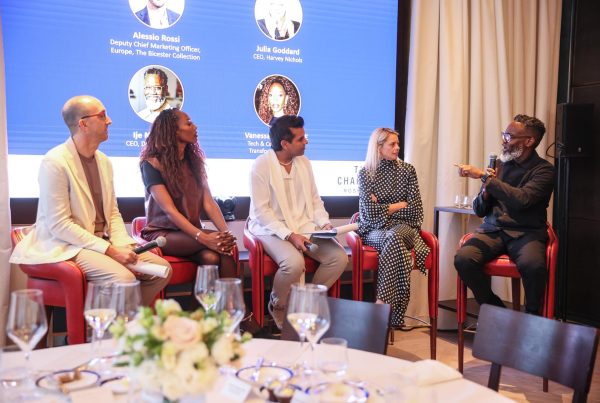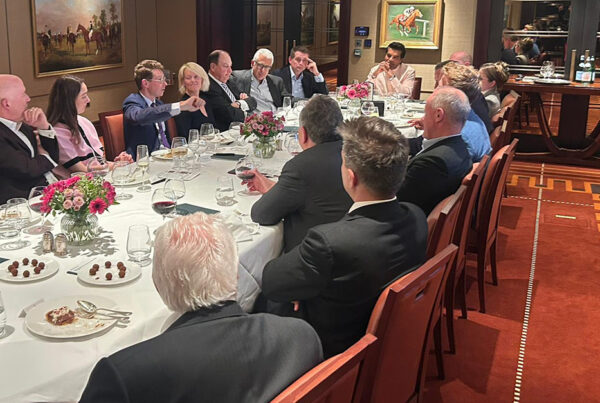


On Thursday, 16 April, Audeliss hosted a CPO Breakfast, bringing together over 40 Chief People Officers for a discussion on the future of the HR function in an AI-driven world.
We were joined by special guest, Andy Doyle, Chief People and Agent Officer at Kantar, to explore how AI is reshaping the People agenda, from re-architecting HR operating models to redefining the skills required of today’s HR leaders. Attendees examined the growing intersection between AI, culture, and trust, and reflected on the opportunities and challenges that come with building more intelligent, responsive, and human-centered organizations.
Reshaping HR for an AI-first future
A central theme throughout the discussion with Andy was that AI is not simply enhancing HR processes but fundamentally reshaping the function itself. Rather than layering technology onto existing ways of working, organizations are beginning to rethink HR from the ground up, designing it as an AI-first operating model. This shift moves HR away from process execution and towards adaptation, governance, and decision-making. In this model, human input becomes more focused on judgment, policy, and experience, while routine interactions are increasingly handled through intelligent systems.
The real challenge is behavioral, not technical
Andy emphasized that the technology itself is not the hardest part of the transformation. Instead, the real challenge lies in shifting mindsets and behaviors. The ability for non-technical teams to build and deploy AI solutions independently is removing traditional barriers, but it requires leaders to foster curiosity, confidence, and a willingness to experiment. Embedding AI into everyday workflows, rather than treating it as a separate initiative, emerged as a critical factor in driving meaningful adoption.
From efficiency gains to work redesign
One of the most significant insights shared was that AI is enabling organizations to move beyond efficiency gains and towards a more fundamental redesign of work. By removing repetitive and administrative tasks, roles can become more focused on high-value, human-centric activities. As Andy noted through examples discussed on the day, this shift has the potential to increase engagement, but it also requires organizations to rethink how roles are structured and what good performance looks like in an AI-enabled environment.
Data quality as a critical foundation
A key learning from early implementation was how quickly AI exposes underlying weaknesses in organizational data. Andy reflected that inconsistent, outdated, or fragmented information can significantly limit the effectiveness of AI tools. As a result, organizations must prioritize the curation, standardization, and governance of their data as a foundational step in becoming AI-enabled.
Trust, governance, and human oversight
As AI becomes more embedded in employee interactions, maintaining trust is essential. Andy highlighted the importance of clear governance, transparency, and defined boundaries for how new AI agents should be built, and where AI should and should not be used. While automation can drive consistency and speed, human oversight remains critical, particularly in sensitive or complex scenarios. This reinforces HR’s evolving role as both a driver of AI innovation and a champion of employee experience.
The evolving skills agenda for HR leaders
The discussion made clear that the shift to an AI-first model is redefining the skills required within HR. Andy pointed to the growing importance of AI fluency, alongside the ability to design and build AI agents, interpret outputs, and apply sound judgment. At the same time, human capabilities such as critical thinking, empathy, and decision-making are becoming even more valuable as work becomes increasingly augmented by technology.
Balancing bottom-up innovation with enterprise control
Andy described a model where organizations encourage widespread experimentation while maintaining strong governance. Empowering individuals to build and use AI tools and agents can accelerate innovation, but without oversight, it can create inconsistency and risk. A balanced approach, combining bottom-up creativity with top-down standards, is therefore essential to scaling AI effectively across the organization.
The impact of AI on culture and employee experience
Beyond operational change, the discussion explored how AI is reshaping workplace culture. As routine tasks are removed, employees are becoming more focused on complex and cognitively demanding work. Andy noted the importance of managing this shift carefully, ensuring that efficiency gains do not translate into unsustainable mental or creative workloads. Organizations must be intentional about how they reinvest capacity, creating space for creativity, development, and reflection.
The discussion highlighted that the future of HR will be defined not by the adoption of AI alone, but by how thoughtfully it is integrated into the organization. Andy’s perspective emphasized both the scale of transformation underway and the responsibility leaders have in shaping it.
As the function evolves towards an AI-first model, HR leaders will play a critical role in balancing technological capability with human experience. Success will depend on the ability to redesign work, build new skills, and create trust in how AI is used. Those who approach this transformation with clarity, curiosity, and a strong sense of responsibility will be best placed to shape a future of work that is both efficient and human-centered.
Watch the key insights from Andy Doyle, Melanie Tansey, Sarah Morris, and Sam Sherrif: