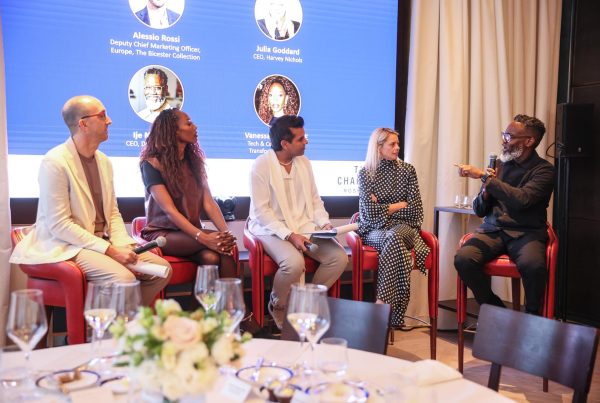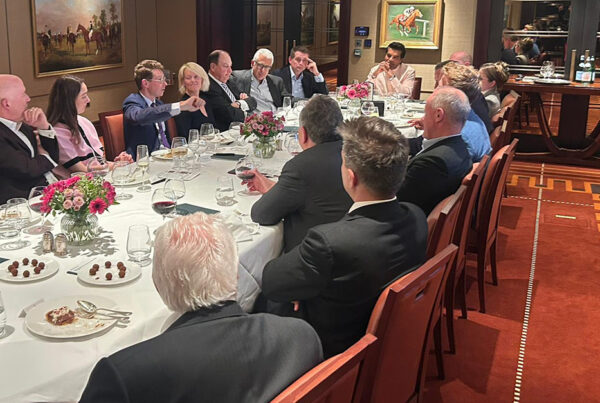


On Wednesday, 26 November, Audeliss hosted the final CEO Dinner of 2025 in partnership with Clifford Chance at Claridge’s in London, bringing together four industry-leading CEOs for an insightful discussion.
As AI continues to transform industries at unprecedented speed, attendees explored the increasingly pivotal role CEOs play in shaping how organizations adapt, innovate, and thrive. The conversation examined the extraordinary opportunities and complex challenges AI presents, from unlocking new efficiencies to redefining customer experiences, and highlighted the critical responsibility senior leaders hold in enabling positive, people-centered, AI-powered transformation across their businesses.
A shifting, global landscape
Attendees reflected on the growing emotional complexity of leading in today’s environment, where external global events and heightened sensitivities shape how people show up at work. Leaders acknowledged that employees increasingly seek reassurance, stability and clarity from senior figures, often without expressing it directly. This shift requires leaders to demonstrate deeper emotional literacy, while also recognizing that the rise of AI and automation is contributing to new anxieties in the workforce. Many noted that supporting people through this transition means helping them understand – and confidently adopt – the tools that will shape the future of their roles. As one attendee observed, the industrial revolution was the transformation of physical labor; the AI revolution is the transformation of cognitive labor – a shift that carries far-reaching emotional and organizational consequences.
The weight of modern leadership
There was also a strong call for leaders to confront difficult questions head-on, particularly those surrounding automation and its impact on roles, skills, and organizational design. Rather than leaning solely into optimism about technological opportunity, leaders recognized the importance of addressing uncomfortable realities openly. As one participant noted, when it comes to the use of AI in business, there is no Plan B – a reminder that avoidance or hesitation only intensifies organizational fear.
In the same vein, attendees highlighted two additional pressures shaping the leadership agenda: the rapid rise of AI agents and the expectation that leaders must become active adopters of AI themselves. Several CEOs noted that while teams are being encouraged to upskill, long-term credibility depends on senior figures demonstrating their own fluency and modelling curiosity, experimentation, and informed decision-making. Without this, organizations risk a capability gap at the very top that slows transformation and undermines confidence.
The discussion highlighted that leadership today is not only about championing the opportunities of AI, but also about acknowledging the human experience within this shift. This includes what one attendee described as the need for a “recognition of the human in the loop” – understanding that every technological decision has an emotional footprint. As AI reshapes job expectations and workplace structures, leaders will increasingly be responsible for modelling calm stewardship and ensuring that fear does not become the organizing principle of their cultures.
Understanding behavior through context
Attendees discussed how easily behavior can be misinterpreted when leaders don’t consider the cultural, historical ,or personal experiences informing it. Seemingly resistant or hesitant responses may be rooted in past experiences of exclusion, rapid organizational change, or fear about technological disruption. Leaders emphasized the need to pause before reacting, to ask better questions, and to understand the narratives that shape how individuals perceive risk, authority, and change. This becomes even more critical as AI adoption accelerates, requiring leaders to meet people where they are and not where the organization expects them to be.
The strategic power of listening
Across the discussion, there was a strong belief that the organizations moving forward fastest are those where leaders have shifted from advocating to listening. Active, curious listening, particularly to discomfort or dissent, was seen as a mechanism for unlocking organizational intelligence and surfacing blind spots before they become risks. Attendees also reflected that as AI tools begin influencing decision-making and workflow, leaders must listen even more attentively to how employees experience these changes. This helps ensure that adoption is human-centered, not imposed, and that people feel empowered rather than displaced.
The expanding mandate of leadership
Attendees noted that leaders are now expected to demonstrate empathy, social awareness, and psychological safety while still delivering traditional performance outcomes. These expectations stack rather than evolve, creating a dual mandate that requires emotional agility and strategic clarity.
The discussion highlighted that as AI reshapes job design and operational models, leaders must balance accelerating innovation with protecting their people from overwhelm. This means guiding teams through change with transparency, equipping them with the skills they need, and ensuring that no one is left behind in the shift toward more technologically enabled work.
Driving progress through honest dialogue
Several attendees reflected on the need for leaders to articulate the uncomfortable truth about performance, readiness, culture, or behavior, even when doing so feels challenging. Avoiding these conversations was described as a short-term kindness that leads to long-term harm. Leaders agreed that honest, fair feedback enables growth and ensures individuals are not blindsided by expectations they didn’t know they were failing to meet. As AI continues to expand capability gaps, this kind of truth-telling becomes even more critical: people need to know where they stand, what skills they must develop, and how to remain relevant in the future world of work.
The emerging AI skills gap
One theme that resonated strongly throughout the evening was the belief that we are entering a new reality with two types of employees: those who know how to work with AI and those who do not. Attendees noted that this divide will increasingly shape career trajectories, organizational capability, and workforce confidence. Those who adapt will help define what the future of work looks like; those who don’t risk being left behind. Leaders agreed that they hold a responsibility not to replace people, but to upskill, empowe,r and prepare them – ensuring AI becomes a tool for widening opportunity, not deepening inequality.
The conversation underscored that modern leadership demands both emotional depth and strategic foresight. Leaders are navigating a world where societal pressures, workforce expectations, and technological disruption intersect, requiring them to communicate with empathy while acting with conviction.
A key takeaway was the collective responsibility leaders share: to guide their organizations through rising complexity, to help their people feel anchored rather than overwhelmed, and to ensure that the transition into an AI-enabled future is equitable, human-centered, and filled with opportunity.
As the pace of change accelerates, the leaders who listen deeply, act courageously, and invest in capability building will be the ones who carry their organizations – and their people – confidently into what comes next.