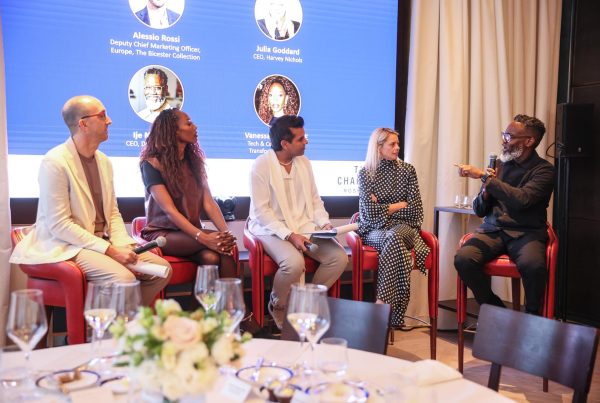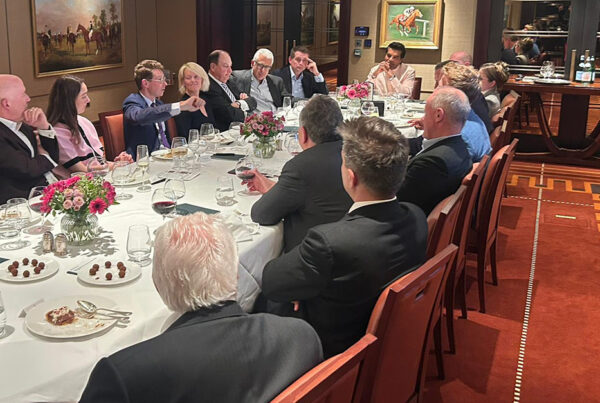


On 2 October, Audeliss hosted a breakfast event bringing together more than 30 Chief People Officers and Chief HR Officers to explore a pivotal question in modern leadership: how is HR evolving from managing transformation to actively driving it? Moderated by Suki Sandhu OBE, Founder and CEO of Audeliss, the conversation featured Line De Decker, CHRO of Haleon, and Sue Whalley, Chief People & Performance Officer at Associated British Foods (ABF). Their discussion shed light on how HR’s role has transformed from a supporting function to a strategic force in shaping business direction and culture.
Transformational leadership in action
Both leaders shared experiences of navigating major organizational transformations.
Sue reflected on her time leading the transformation of a century-old, unionized postal business following an IPO. The challenge was not only technological, such as introducing parcel-tracking systems and digital devices, but also deeply human. Altering how 100,000 employees worked required transparent communication, partnership with unions, strong frontline leadership as well as culture change and greater empowerment for leaders. She highlighted that while technology change can be complex the real and deeper challenge lies in helping people adapt to new ways of working through sustained training and dialogue.
Line, meanwhile, shared insights from Haleon’s spin-off from GSK and Pfizer, which was a monumental corporate transformation. For her, success relied on top-team alignment and what she described as eliminating “meeting room violence and hallway silence.” Building unity at the top, maintaining transparency, and managing at speed were key lessons. Her emphasis on building “buffer time” into transformation plans for unexpected developments demonstrated the pragmatic agility required of HR leaders today.
HR as a change architect
The conversation revealed a clear shift: HR is no longer just facilitating change but creating it. Both speakers described how the broader business strategy drives organizational and cultural transformation. For Line, her HR background made her uniquely positioned to lead Haleon’s transformation, as communication, transparency, and people engagement were central to its success.
Sue noted that in large-scale change, HR plays a dual role: both a strategic enabler and a cultural stabilizer. However, she warned that other business leaders can still incorrectly see change as “HR’s job,” when in reality, it is the collective responsibility of all leaders, with HR setting the pace, tone, and structure, and bringing expertise. The biggest challenge can be supporting leadership throughout the organization, especially front-line managers, to lead change.
Barriers to transformation
When exploring barriers to successful change, both guests offered deeply reflective answers. Sue identified three recurring obstacles: the misconception that HR alone owns transformation, the overemphasis on technology over adoption, and human resistance to change, especially in the context of automation and AI. She observed that the real value of transformation emerges after implementation, when organizations must embed new behaviors and extract insight from data in order to capture value from investments.
Line distinguished between personal and institutional barriers. On a personal level, she spoke about the emotional toll of transformation, such as the human stories behind layoffs, relocations, and restructuring, and how empathy must remain central to leadership. Institutionally, she pointed to data misuse: organizations that are “data rich but insight poor” rely too heavily on benchmarks rather than understanding their own specific goals.
The power of partnership: CPO, CIO, and CFO
Technology’s growing influence was a major theme, particularly the evolving partnership between CPOs and CIOs. Line noted that some organizations now have CIOs reporting into CHROs, an indicator of HR’s growing importance to workforce technology strategy. At Haleon, this partnership is manifested in collective education: HR teams are learning about AI to ensure they can engage with it strategically rather than reactively.
Sue expanded this to a “triangle” model, listing CPO, CIO, and CFO as the foundation of successful transformation. People, technology, and finance must align for change to succeed. She described ABF’s approach of integrated project governance, where HR, IT, and finance co-lead initiatives, ensuring mutual understanding and accountability as well as the power of joint business partnering across the three functions.
Leading change with the board
An audience question about engaging boards during transformation drove insightful responses. Both guests stressed the importance of simplicity and clarity. Line described her approach of refining complex transformation updates into a concise three-page summary that focused on enterprise risks and what was needed from the board. Sue echoed this, noting that if a transformation strategy cannot be explained on two or three pages, it likely lacks clarity. Both agreed that boards respond best to clear narratives linking risk, purpose, and measurable outcomes.
Sustaining change and avoiding regression
Another challenge discussed was sustaining transformation once the initial momentum fades. Sue spoke about ABF’s use of digital coaching tools embedded in new systems to guide employees in real time and reinforce new behaviors. She also highlighted the importance of continuously revisiting the “why” behind transformation through regular forums and feedback loops.
Line pointed out that simplification is key: if employees cannot easily grasp a change, it will not stick. She encouraged HR leaders to test training themselves, ensuring it is intuitive and relevant before deployment.
The external orientation of HR
As organizations increasingly operate in complex ecosystems, both speakers acknowledged that HR must look beyond internal structures to external stakeholders. Line described efforts to embed more external focus into her HR teams by hiring leaders from business functions such as manufacturing or general management. She argued that understanding customer value creation and external growth drivers is essential for a future-ready HR function.
Sue reinforced this point by highlighting the need for HR leaders to stay informed about technological shifts, supply chain dynamics, consumer trends, and global demographics. Bringing “the outside in” allows HR to design people strategies that reflect the changing realities of the workforce and marketplace.
AI and the future of HR
The conversation turned to AI’s growing role in reshaping HR. Line encouraged a disciplined approach: before automating, leaders must first “eliminate and simplify.” She described how some organizations focus on removing time-consuming work that doesn’t add real value and simplifying processes before layering AI solutions, ensuring that automation enhances, rather than muddles, how people work.
Sue shared that ABF is experimenting with AI tools to enhance productivity in HR operations. These technologies are being introduced through pilot projects governed jointly by HR, finance, and technology teams, ensuring balanced oversight and learning.
Resilience and recovery
Transformation needs resilience not only organizationally but personally. Both leaders discussed the importance of energy management and recovery. Line borrowed lessons from professional sport, adding deliberate “recovery moments” after peak transformation activity to sustain her team’s energy. Sue echoed this, describing how ABF invests in resilience training focused on self-care, mindfulness, and sleep. As she put it, leaders must “put their oxygen masks on first” to effectively support others.
Conclusion
The discussion revealed that HR has moved from the back office to the boardroom, from managing change to designing it. The modern CPO is a strategist, technologist, and communicator all in one. As organizations face accelerating technological, demographic, and cultural shifts, HR’s evolution into a driver of transformation is not optional but essential.
The event emphasized that the future belongs to HR leaders who can unite people, technology, and purpose and influence multiple stakeholders; those who communicate clearly, act with empathy, and think boldly about the role of people in shaping tomorrow’s businesses.