
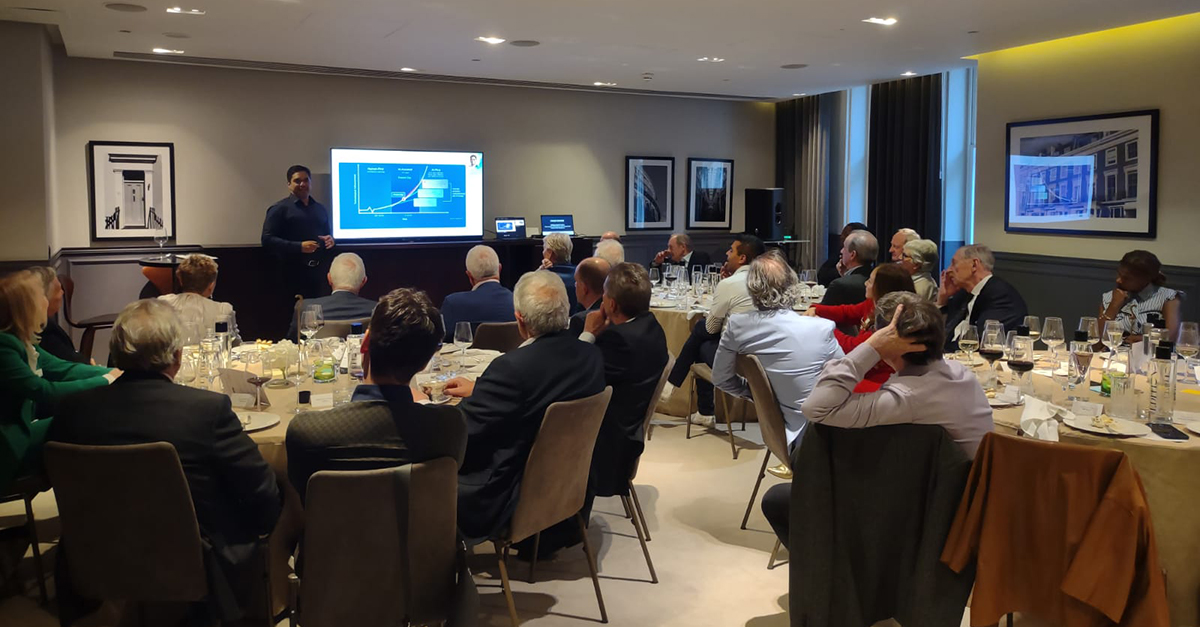

On 21 May, Audeliss hosted an intimate and insightful dinner for Chairs, featuring a dynamic presentation by Lisa Smith, Equity Partner and UK & Global Emerging Tech Leader at Deloitte Digital, and Piers Linney, Co-Founder of Implement AI. The evening centered around one of the most pressing and transformative issues facing leadership today: the rise of Generative AI and its implications for the boardroom.
The event prompted Chairs to examine where their organizations stand in their AI journey and how prepared they are for what’s coming next. Through a series of practical demonstrations, real-world examples, and an open dialogue with attendees, Lisa and Piers painted a compelling picture of both the immense opportunity and the operational responsibility that AI brings.
Key Learnings
With a career that connects leadership, social impact, and operational excellence, Lisa set the tone for the evening by directing the conversation to the human experience: how leaders can use technology to elevate people. Her framing of Gen AI not as just a product but as a journey, where readiness, acceleration, and enterprise transformation are stages every organization must pass through, was an invitation for attendees to assess their current position and take practical, deliberate steps forward.
Pragmatic optimism: tools, not threats
One of the key points of the evening was that AI is not about sidelining humans but enabling them to evolve their role and approach. Gen AI, as explained by both Lisa and Piers, is a “thinking tool” – a way to shift employees from task-based work to value-based work. Whether it’s fusing knowledge to support decision-making, accelerating data processing in the finance department, or enabling 24/7 empathetic customer service through AI agents, the goal is to help humans spend more time doing meaningful work. Far from belittling human capability, the message was that AI allows our cognitive and emotional intelligence to flourish in ways that weren’t possible before.
Exponential change and the challenge of leadership
Piers’ analogy of AI development as an “exponential curve” distinctly illustrated the urgency facing today’s boardrooms. Just as COVID-19’s global spread demonstrated how slow initial signals can erupt into worldwide transformation, AI is now moving from experimental to essential at a remarkable speed. His message was clear: leaders who treat Gen AI as a future problem risk being left behind. But rather than fearmongering, Piers focused on the empowerment AI brings, giving leaders enhanced foresight, rapid responsiveness, and the ability to unlock efficiencies that were not considered before.
Ethics, bias, and the social divide
The discussion didn’t shy away from the more uncomfortable realities. Chairs in attendance raised concerns about the risk of aggravating inequalities and embedding bias into systems that lack diverse data sets. Lisa acknowledged these as pressing challenges and highlighted the importance of embedding diversity into every layer of AI development, from data infrastructure to the people building the models. She also pointed out the potential silver lining: AI can make it easier to find and use diverse models and voices if companies make intentional efforts to change the base. The call to action was clear: AI must be deployed alongside a commitment to inclusive innovation, closing the digital divide, and correcting the systemic biases of the past.
Augmentation over automation
Piers frequently spoke about augmentation. AI isn’t here to replace human judgment, but to support and sharpen it. The examples shared in the room, including customer support agents that can hold empathetic conversations at 2am and AI co-pilots for strategy and auditing, painted a future where AI becomes a powerful partner in human-led decision-making. This is especially true in the boardroom, where ambiguity and gut instinct play a central role; the role of AI is to inform, not dictate. The technology may evolve toward Artificial General Intelligence (AGI), but in the current state, it amplifies human decision-making rather than overrides it.
Reframing the role of the board
Perhaps one of the most subtle yet significant shifts proposed was around board composition and readiness. Who owns AI in an organization? It’s not always the CTO or the CDO, and it was pointed out that not one existing board or C-suite role really has the skillset or current remit to understand and implement AI at scale across the business. Lisa suggested that the best people to lead this transformation might be the best operators, who understand the business intimately and can integrate AI into its core functions. Piers echoed this sentiment, advocating for boards to build working groups or appoint dedicated AI leads who can bridge technological fluency and business strategy.
Creativity, originality, and the future of work
A thoughtful segment of the discussion tackled the concern that AI could homogenize thought and creativity. While Gen AI is powerful in repurposing and reformatting knowledge, audience members rightfully questioned whether AI could innovate in truly human ways. The consensus was nuanced: while AI can synthesize vast pools of information and even generate novel outputs, true innovation still requires the human touch. For now, AI supports creativity without owning it. This human-machine partnership will define the next era of work, with skill sets becoming more fluid and adjacent, and job roles morphing into broader work types.
Conclusion
The event was not just a technical deep dive into Gen AI; it was a powerful reflection on the evolving contract between humans and technology. Lisa and Piers both pushed the audience to recognize that AI is not about diminishing human value but about unlocking it. Boards must lead with curiosity, courage, and clarity, understanding that this technological era offers a generational opportunity to reimagine how we work, who we include, and what kind of future we want to build.
By adopting AI responsibly and intentionally, organizations can not only enhance performance but also advance inclusion, creativity, and strategic thinking. The choice is not between humans or machines; it is about building better futures through their collaboration.